New workshop dates added : 18.10.2026 + 25.10.2026 + 15.11.2026
Calligraphy vs. Handwriting.
Why you don't need neat handwriting to learn modern calligraphy.
Nash
6/23/20261 min read
“I have terrible handwriting, so I could never learn calligraphy.”
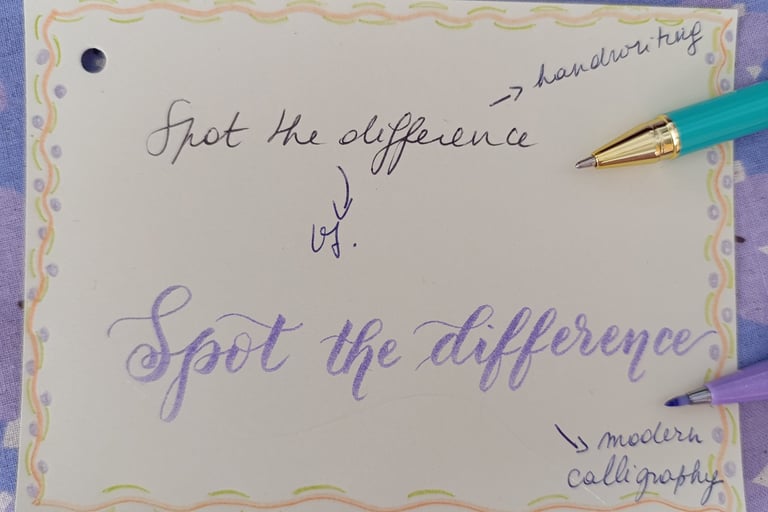
This is something I hear often, but the truth is: calligraphy and handwriting are two completely different skills.
Handwriting is the way we naturally write every day — quick, personal, and often influenced by habit or how we learned at school. Each letter is practically formed in one stroke with little to no interruption between the letters, and each letter have the same thickness throughout. In calligraphy, the letters of the alphabet are made of a series of individual strokes, also known as the basic strokes, combining thin and thick strokes. As a rule, whenever your pen goes in an upward direction, the stroke should be thin; and when the stroke goes down, it should be thick. This requires a specific nib that allows the control of releasing less or more ink when applying little or more pressure. And letters are primed by joining these strokes, slowly, one at a time, lifting your pen after each stroke, transitioning smoothly from thin to thick strokes by applying the right pressure where needed.
Like any skill, calligraphy improves with practice. You learn how to hold your pen, control your movements, form letters, and create beautiful words through patience and repetition. yes repetition is the key, to build muscle memory in order to get consistency in te shape, and spacing of your letters.
So if you’ve always wanted to try calligraphy but thought your handwriting wasn’t good enough, don’t let that stop you.
You don’t need perfect handwriting. You just need curiosity, a willingness to practise, patience, and the joy of creating something beautiful by hand
© 2026 by Crafty Nib. Created with Hostinger
Get in touch : mycraftynib@gmail.com